
Google Workspace vs Microsoft 365 for Small Business: Which One Should You Choose?
When small business owners ask me to compare productivity platforms, the discussion usually comes down to google workspace vs microsoft 365 for small business. I have seen both platforms used across different industries, and the right choice often depends on how a business works today and how it plans to grow.
Productivity tools are no longer just about email and documents. They directly impact collaboration, security, compliance, and even customer trust. That is why this decision deserves careful thought.
Why small businesses must choose the right productivity platform
Small businesses operate with limited resources and tight timelines. Every tool needs to be simple, reliable, and secure. Email downtime, file access issues, or poor collaboration can quickly affect operations.
In many environments I work with, productivity platforms are closely tied to broader modern workplace solutions, identity management, and security controls. Choosing the right platform early helps avoid costly migrations later.
Understanding Google Workspace for small businesses
Google Workspace focuses on cloud first collaboration. It includes Gmail, Google Drive, Docs, Sheets, Slides, Calendar, and Meet.
Where Google Workspace works best
In my experience, Google Workspace is ideal for teams that value speed and flexibility.
- Easy onboarding for new users
- Strong real time collaboration
- No dependency on desktop applications
- Smooth experience for remote teams
Businesses that rely heavily on browser based work and shared documents often find Google Workspace easier to adopt.
Limitations to keep in mind
However, Google Workspace may feel limiting in certain scenarios.
- Advanced document formatting is basic
- Spreadsheet power users may miss Excel features
- Enterprise level security and compliance controls are limited
For businesses dealing with sensitive data, this often leads to conversations around cloud security challenges and governance maturity.
Understanding Microsoft 365 for small businesses
Microsoft 365 offers a more comprehensive ecosystem with Outlook, Word, Excel, PowerPoint, OneDrive, Teams, and SharePoint.
Why many businesses choose Microsoft 365
From what I have seen, Microsoft 365 works extremely well for structured environments.
- Powerful desktop and cloud applications
- Advanced email and calendar management with Exchange Online
- Strong collaboration through Microsoft Teams and SharePoint
- Deep integration with identity and access controls
Many organizations pair Microsoft 365 with Microsoft 365 consulting services to ensure correct setup, security hardening, and long term scalability.
Challenges with Microsoft 365
Microsoft 365 does come with complexity.
- Initial configuration can be overwhelming
- Requires planning around identity and access management
- Collaboration features need proper governance
Without guidance, businesses may not fully benefit from built in security features such as conditional access and Zero Trust alignment.
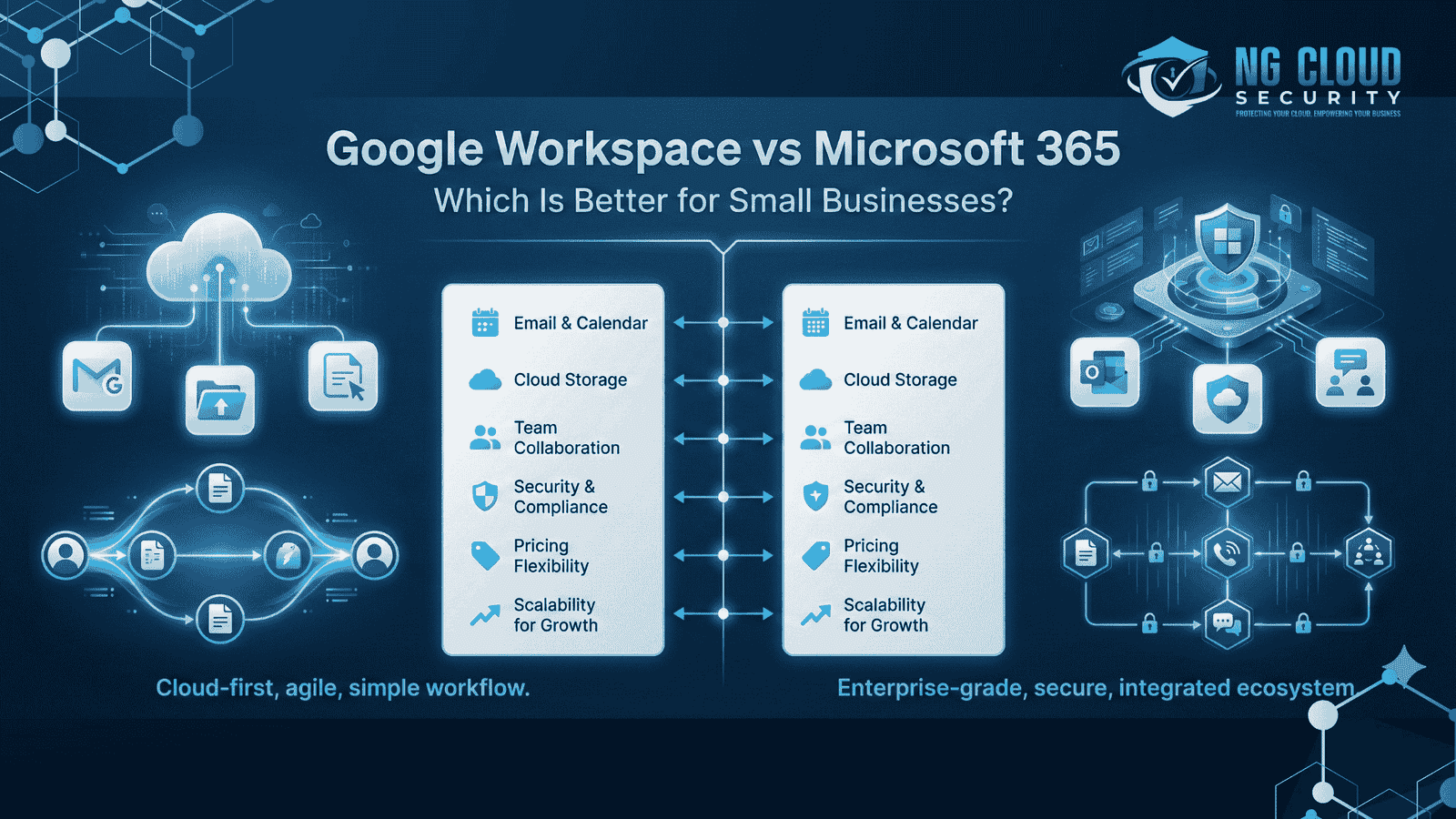
Google Workspace vs Microsoft 365 for small business collaboration
Collaboration is a major deciding factor in the google workspace vs microsoft 365 for small business debate.
Google Workspace excels in real time document editing. Multiple users can work simultaneously with minimal friction. This works well for creative teams and fast moving startups.
Microsoft 365 offers more structured collaboration. Teams, SharePoint, and OneDrive support role based access, approvals, and document lifecycle management. This becomes important as businesses grow and adopt formal processes.
Organizations focused on secure collaboration often align Microsoft 365 with modern identity and access management IAM strategies.
Security and compliance considerations
Security is often underestimated by small businesses until an incident occurs.
Microsoft 365 provides advanced capabilities such as identity protection, data loss prevention, and compliance management. These features are commonly reviewed during a Microsoft 365 security assessment to ensure proper configuration.
Google Workspace provides strong baseline security, but it may not meet regulatory expectations in highly regulated industries.
If your business handles confidential customer data, choosing a platform that supports Zero Trust principles and compliance readiness is critical.
Pricing and long term scalability
Google Workspace pricing is simple and predictable, which appeals to smaller teams.
Microsoft 365 offers more plans and flexibility. While it may seem complex, it allows businesses to scale gradually and add advanced security, compliance, and management features when needed.
Many growing organizations later explore Microsoft 365 managed services to optimize costs and reduce operational overhead.
Choosing the right plan also matters, which is why many businesses work with trusted Microsoft 365 license providers in India like us, to select cost effective licenses that match their growth and security needs.
Final recommendation
So when deciding between google workspace vs microsoft 365 for small business, the best choice depends on how your team works and where your business is headed.
Choose Google Workspace if your priority is simplicity, quick collaboration, and minimal administration.
Choose Microsoft 365 if you need advanced productivity tools, stronger security controls, and a platform that scales with structured growth.
From my experience, businesses that align productivity tools with security and long term strategy always gain more value. The right decision today can save time, money, and risk tomorrow.
